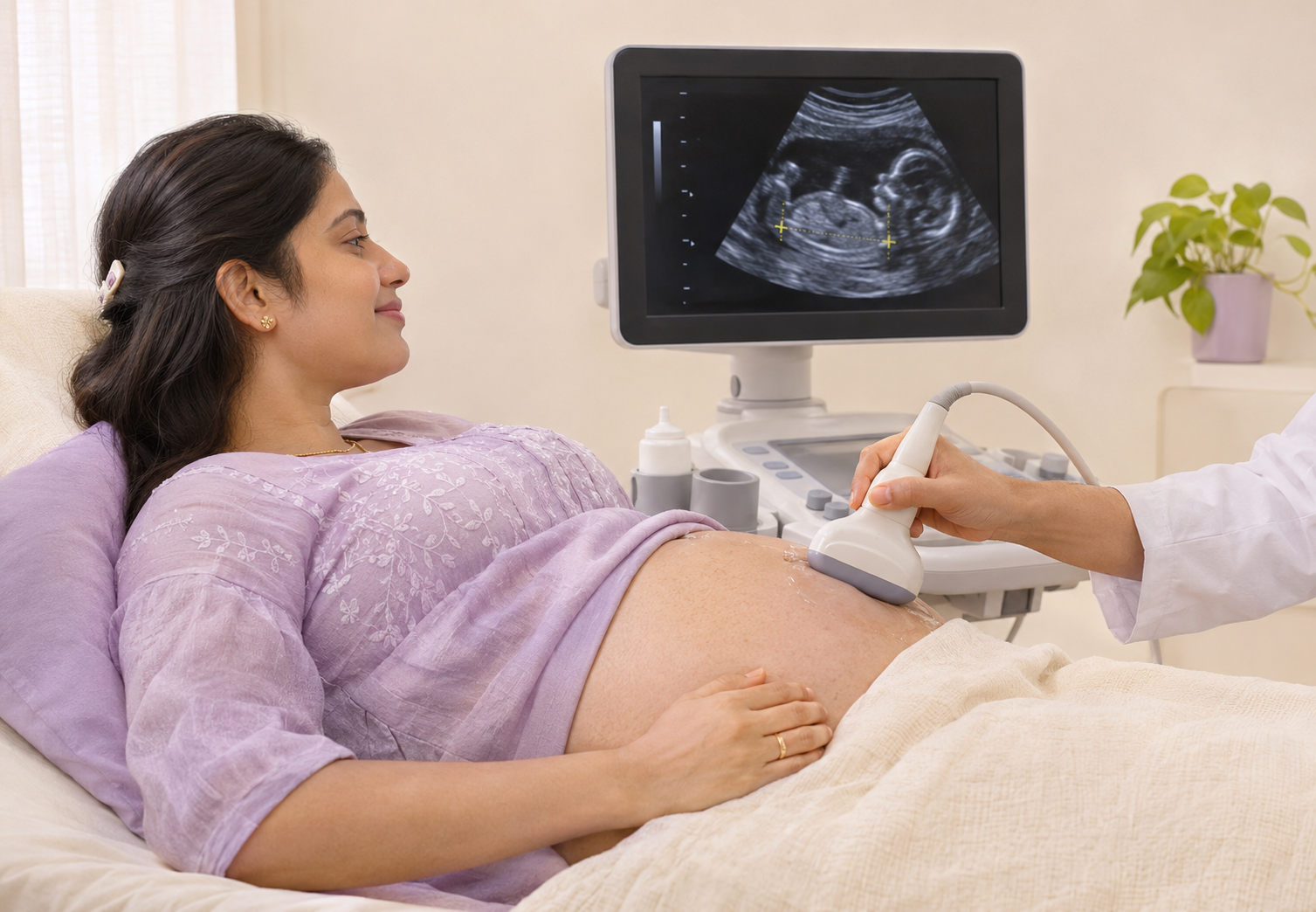
Monitoring your baby's growth is an important part of antenatal care. As pregnancy progresses, doctors may recommend ultrasound scans to check the baby's size, position, movements and overall development. One such examination is a growth scan, which helps assess whether the baby is growing as expected for the stage of pregnancy. Many expectant parents ask, when is growth scan done and whether every pregnancy requires one. The timing depends on your pregnancy history, routine antenatal findings and any medical concerns. Understanding the purpose of this scan can help you prepare for your appointment and know what information it provides.
What Is a Growth Scan During Pregnancy?
If you are wondering what is a growth scan, it is an ultrasound examination used to assess the baby’s size and growth inside the uterus. It is generally performed later in pregnancy, although the exact timing depends on individual needs and the advice of your obstetrician.
A growth scan ultrasound measures different parts of the baby’s body, including the head, abdomen and thigh bone. These measurements are used to estimate the baby’s weight and compare it with expected growth patterns for the gestational age.
The scan may also assess the amount of amniotic fluid around the baby, the baby’s position and, when indicated, blood flow through certain blood vessels using Doppler ultrasound. These findings help doctors decide whether additional monitoring or care is needed.
When Is Growth Scan Done During Pregnancy?
For many pregnancies, a growth scan may be recommended between 28 and 32 weeks, depending on the clinical situation and local practice. Some scans are performed later, around 32–36 weeks, when the doctor needs to assess growth closer to the expected delivery date.
The answer to when is growth scan done is not the same for everyone. A woman with a low-risk pregnancy may not need a separate growth scan if routine assessments are reassuring. However, a scan may be advised if there are concerns about the baby’s size, maternal health or placental function.
A growth scan may be recommended when:
- The baby’s size seems smaller or larger than expected during an antenatal examination.
- The mother has high blood pressure, diabetes or certain other medical conditions.
- There is a history of fetal growth restriction or pregnancy complications.
- The pregnancy involves twins or multiples.
- There are concerns about amniotic fluid levels or placental function.
Your obstetrician will determine the most appropriate timing based on your pregnancy and medical history.
Week-by-Week Guide to Growth Scans
The right time for a scan depends on why it is being performed. The following guide explains when growth assessment may be considered during the second half of pregnancy.
24–27 Weeks: Assessing Growth Concerns
A growth scan is not routinely required for every pregnancy at this stage. However, an earlier assessment may be recommended if there are concerns about the baby’s development, maternal health or previous ultrasound findings.
The scan may help identify whether the baby is measuring smaller or larger than expected and whether further monitoring is necessary.
28 Weeks: Beginning Third-Trimester Growth Assessment
A scan at 28 weeks may be useful when a doctor wants to assess fetal growth earlier in the third trimester. It can provide measurements of the baby’s head, abdomen and thigh bone, along with an estimated fetal weight.
Whether a scan is needed at this stage depends on individual risk factors and the findings of previous examinations.
30–32 Weeks: A Common Growth Assessment Period
For some pregnancies, this is a common period for a growth assessment. The doctor can compare the baby’s measurements with expected growth patterns and assess the amniotic fluid level.
When discussing growth scan in which week, it is important to remember that there is no single week suitable for every pregnancy. The timing should be based on clinical advice rather than a fixed schedule.
32–34 Weeks: Monitoring the Baby’s Development
A scan during this period may be recommended if the doctor needs to monitor the baby’s growth or follow up on an earlier finding. It can help assess whether growth is progressing as expected and whether additional checks are needed.
A growth scan in pregnancy may also be combined with Doppler assessment when there is a medical reason to examine blood flow through the placenta or umbilical artery.
34–36 Weeks: Checking Growth Closer to Delivery
A later scan may help assess the baby’s estimated weight, position and amniotic fluid level. These details can contribute to planning further antenatal care and delivery, particularly when there are concerns about growth or other pregnancy complications.
The answer to when is growth scan done may therefore vary according to the purpose of the examination and how the pregnancy is progressing.
After 36 Weeks: Additional Assessment When Needed
A scan after 36 weeks may be recommended if the doctor needs updated information about the baby’s growth, position or fluid levels. It is not automatically necessary for every pregnancy.
The decision depends on the mother’s health, the baby’s condition and whether the findings could influence further monitoring or delivery planning.
What Does a Growth Scan Ultrasound Check?
A growth scan ultrasound provides several measurements and observations that help doctors assess the baby’s development.
- Head measurements: Used to assess the size of the baby’s head.
- Abdominal circumference: Helps estimate fetal size and growth.
- Femur length: Measures the length of the baby’s thigh bone.
- Estimated fetal weight: Calculated using ultrasound measurements to estimate the baby’s weight.
- Amniotic fluid: Assesses the amount of fluid surrounding the baby.
- Baby’s position: Shows whether the baby is head-down, breech or in another position.
- Doppler blood flow, when indicated: Evaluates circulation in selected blood vessels to help assess placental function.
Ultrasound weight estimates are not exact. A baby’s measurements need to be interpreted in context, and a single scan may not provide the complete picture of growth over time.
Is a Growth Scan Necessary for Every Pregnancy?
Not every pregnant woman needs a separate growth scan. Routine antenatal care includes checking the mother’s health and monitoring the baby’s growth through clinical assessments. If there are concerns, an ultrasound may be recommended to obtain more detailed information.
Doctors may suggest one or more scans for pregnancies involving diabetes, high blood pressure, suspected fetal growth restriction, multiple babies or other relevant risk factors.
If a scan shows that the baby is smaller than expected, the doctor may review previous measurements, assess amniotic fluid and consider Doppler studies or follow-up scans. A smaller measurement does not always mean that the baby has a health problem; some babies are naturally small.
Growth Scan in Chandigarh at Garbh Fetal Medicine & Diagnostic Centre
Choosing an appropriate ultrasound centre can help you access detailed fetal assessment and clear explanations of scan findings. If you are looking for a growth scan in chandigarh, Garbh Fetal Medicine & Diagnostic Centre offers pregnancy ultrasound services to support antenatal assessment.
The centre focuses on fetal imaging and pregnancy-related diagnostic evaluation. Your scan should be selected according to your obstetrician’s advice, gestational age and medical needs.
For parents asking when is growth scan done, the team can help explain the purpose of the examination and the information it may provide. A scan report should always be interpreted alongside your pregnancy history and the advice of your treating doctor.
If you need a growth scan in Chandigarh, contact Garbh Fetal Medicine & Diagnostic Centre to enquire about appointment availability, scan preparation and the referral or medical information you may need to bring.
Conclusion
A growth scan can provide useful information about your baby’s development, estimated weight, position and the amniotic fluid level. The appropriate timing depends on your pregnancy history and any concerns identified during routine antenatal care.
If you are unsure when is growth scan done in your case, speak with your obstetrician rather than relying on a standard week alone. Garbh Fetal Medicine & Diagnostic Centre can help you enquire about pregnancy ultrasound services and understand the role of fetal imaging in antenatal care.
FAQs
When is a growth scan done during pregnancy?
Ans.A growth scan may be recommended during the third trimester, often around 28–32 weeks or later, depending on the pregnancy. It may be performed earlier or repeated if there are medical concerns.
In which week is a growth scan usually recommended?
Ans.There is no universal week for every pregnancy. A scan may be advised between 28 and 32 weeks, while some women may need assessment around 32–36 weeks based on their doctor’s recommendation.
Can a growth scan be done at 28 weeks of pregnancy?
Ans.Yes. A scan can be performed at 28 weeks when there is a clinical reason to assess the baby’s size, estimated weight, fluid levels or other aspects of development.
Is a growth scan necessary at 32 weeks?
Ans.Not always. It may be recommended at 32 weeks if the doctor wants to assess growth or follow up on a pregnancy concern. The need depends on your individual circumstances.
Can a growth scan be done after 36 weeks of pregnancy?
Ans.Yes. A scan after 36 weeks may be performed when updated information about fetal growth, position or amniotic fluid is needed.
How many growth scans are needed during pregnancy?
Ans.There is no fixed number. Some women may not need a separate growth scan, while others may require repeat scans to monitor growth or follow up on medical concerns.
What does a growth scan ultrasound check?
Ans.It assesses the baby’s measurements, estimated weight, amniotic fluid and position. Doppler blood flow may also be evaluated when clinically indicated.
Is a growth scan necessary for every pregnancy?
Ans.No. It is recommended when clinically appropriate. Your obstetrician can decide whether routine monitoring is sufficient or an ultrasound is needed.
What happens if a growth scan shows that the baby is smaller than expected?
Ans.The doctor may review the measurements, compare them with previous scans and assess amniotic fluid and blood flow if needed. Follow-up monitoring may be recommended to determine whether the baby is growing appropriately.
What is the difference between a growth scan and a Doppler scan?
Ans.A growth scan primarily assesses the baby’s size, estimated weight and amniotic fluid. A Doppler scan evaluates blood flow through selected vessels. Doppler assessment may be added to a growth scan when there is a clinical reason.


